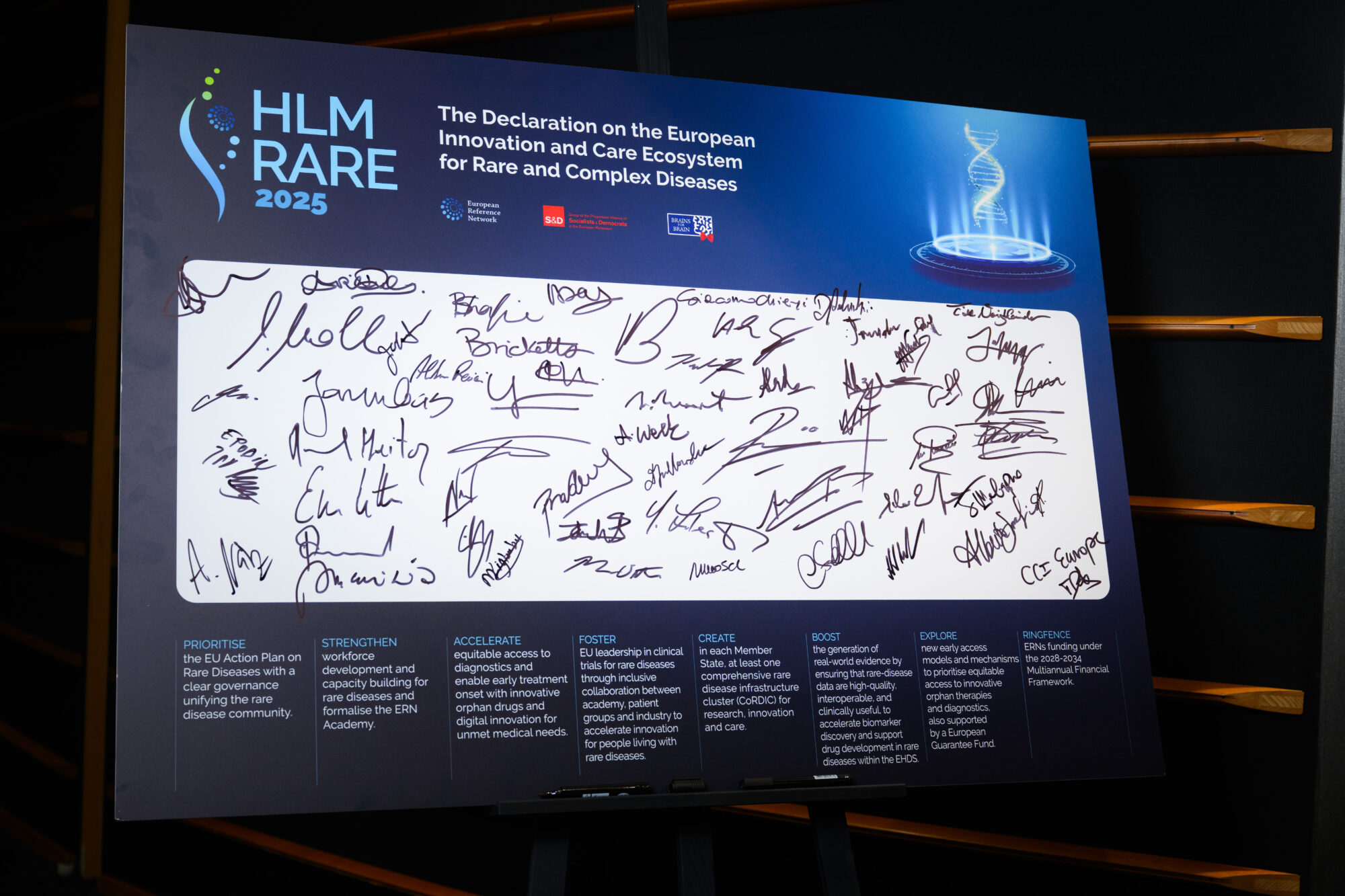
During HLM Rare 2025 we launched the Declaration on the European Innovation and Care Ecosystem for Rare and Complex Diseases. This Declaration is a political and strategic commitment to fundamentally transform our ecosystem.
It examines how to strategically place research and innovation at the heart of EU life science and health policy, using rare diseases as a model to showcase the EU’s added value. Moreover, it serves as a critical document that mobilises key stakeholders to re-establish the EU’s pivotal leadership role in rare diseases and life sciences globally.
The Declaration sets out a shared vision, strategic priorities and a roadmap that foresees the creation of Working Groups to develop concrete Plans of Action, aimed at accelerating progress in rare and complex diseases, including increasing available treatments and expanding newborn screening and advanced diagnostics.
The Declaration has been endorsed and formally signed by more than 2.000 stakeholders:
Over the three days of our event, each panel discussed, tested and refined specific priorities and recommendations that the Declaration puts forward, so that this document becomes not just a statement of intent, but a practical guide for joint action in the years ahead.
The declaration’s roadmap for priority action
All the following eight priority actions are deemed equally crucial and necessitate a more coherent political framework, supported by dedicated, earmarked resources:
Foundational signatures
HLM Rare 2025 Hosts
- Vytenis Andriukaitis, Member of the European Parliament (S&D, Lithuania) and host of the High-Level Meeting
- Maurizio Scarpa, Founder and Co-Chair of Brains for Brain Foundation, Coordinator European Reference Network for Hereditary Metabolic Diseases (MetabERN), and host of the High-Level Meeting
European Reference Networks
- Alexis Arzimanoglou, European Reference Network for Rare and Complex Epilepsies (EpiCare) Coordinator
- Hélène Dollfus, European Reference Network for rare eye diseases (ERN-EYE) Coordinator
- Holm Graessner, European Reference Network for Neurological Disorders (ERN-RND) Coordinator
- Peter Mulders, European Reference Network for Rare Uro-Recto-Genital Diseases and Complex Conditions (EUROGEN) Coordinator
- Ruth Ladenstein, European Reference Network for Paediatric Oncology (PaedCan) Coordinator
- Marjolijn Ligtenberg, European Reference Network on genetic tumour risk syndromes (ERN GENTURIS) Coordinator
- Marta Mosca, European Reference Network of Connective Tissue and Musculoskeletal diseases (ERN ReCONNET) Coordinator
- Mari Murel, ERN Guard-Heart Network Project Manager
- Mar Mañu Pereira, European Reference Network on Rare Hematological Diseases (ERN-EuroBloodNet) Coordinator
- Alberto Pereira, European Reference Network for Rare Endocrine Conditions (Endo – ERN) Coordinator, Adult Chair
- Alessandra Renieri, European reference network for rare malformation syndromes and rare intellectual and neurodevelopmental disorders (ERN ITHACA) Project Manager
- Luca Sangiorgi, European Reference Network on Rare Bone Diseases (ERN-BOND) Coordinator
- René Wijnen, European Reference Network for rare Inherited and Congenital (digestive and gastrointestinal) Anomalies (ERNICA) Coordinator
- Anneke Werk, European Reference Network on on hepatological diseases (ERN RARE-LIVER) Project Manager
Members of the European Parliament
- Christel Schaldemose, Vice-President of the European Parliament and Member of the European Parliament (S&D, Denmark)
- Stine Bosse, Member of the European Parliament (Renew, Denmark)
- Nicolás González Casares, Member of the European Parliament (S&D, Spain) and member of Panel for the Future of Science and Technology (STOA)
- Adam Jarubas, Member of the European Parliament (EPP, Poland) and Chair of the SANT Committee
- Nikos Papandreou, Member of the European Parliament (S&D, Greece)
- Tomislav Sokol, Member of the European Parliament (EPP, Croatia)
- András Tivadar Kulja, Member of the European Parliament (EPP, Hungary)
- Aurelijus Veryga, Member of the European Parliament (ECR, Lithuania)
- Vlad Voiculescu, Member of the European Parliament (Renew, Romania)
- Christophe Clergeau, Member of the European Parliament (S&D, France)
- Eero Heinäluoma, Member of the European Parliament (S&D, Finland)
- Ignazio Marino, Member of the European Parliament (Greens, Italy)
- Kristian Vigenin, Member of the European Parliament (S&D, Bulgaria)
- Leire Pajín, Member of the European Parliament (S&D, Spain)
- Marta Temido, Member of the European Parliament (S&D, Portugal)
- Peter Liese, Member of the European Parliament (EPP, Germany)
- Romana Jerković, Member of the European Parliament (S&D, Croatia)
- Seán Kelly, Member of the European Parliament (EPP, Ireland)
Former policy-makers
- Manuel Heitor, Former Portuguese Minister of Science, Technology, and Higher Education
- Enrico Letta, President of the Jacques Delors Institute and former President of the Italian Council of Ministers
Patient Organisations
- Avril Daly, President, EURORDIS-Rare Diseases Europe
- Dariusz Adamczewski, Managing Director, Children’s Tumor Foundation Europe
- Teresa Pais, Senior Policy Officer, Childhood Cancer International Europe
- Johan Prevot, Executive Director, International Patient Organisation for Primary Immunodeficiencies (IPOPI)
- Kacper Ruciński, Public Health Expert, SMA Foundation Poland
- Dominique Sturz, ERN Eye ePAG chair
- Theodora Weisz, Patient Advocate
Professional Societies & Research Institutes/organisations/projects
- James R. Bonham, President of the International Society of Neonatal Screening (ISNS)
- Silvio Brusaferro, Former President, Italian Institute of Health (2019-2023)
- Alessandra Ferlini, University of Ferrara, Italy & Scientific Coordinator of the EU-IHI Screen4Care project
- Liesbet Geris, Professor Biomedical Engineering, Université of Liège and KU Leuven; Executive Director VPH Institute, Belgium
- Ralf Dieter Hilgers, RealiseD Coordinator and Sigmund Freud Private University Vienna
- Daria Julkowska, European Rare Diseases Research Alliance (ERDERA) Coordinator
- Michael Marmot, Director of the UCL Institute of Health Equity, London
- Leonidas A. Phylactou, CEO and Medical Director, The Cyprus Institute of Neurology and Genetics
- Ana Rath, Orphanet Director, INSERM
- Till Voigtländer, Coordinator JARDIN Joint Action
- Nicola Specchio, Chair International League Against Epilepsy European region ( ILAE-Europe)
- Kevin Rostasy, President European Society of Paediatric Neurology
- Manuel del Castillo, CEO, Hospital Sant Joan de Déu, Barcelona, Spain
- Massimiliano Raponi, Medical Director, Ospedale Pediatrico Bambino Gesù, IRCCS, Rome, Italy
Industry
- Anne-Sophie Chalandon, Head of Global Rare Disease Policy, Sanofi
- Giacomo Chiesi, Executive Vice President, Global Rare Diseases, Chiesi Group
- Jane Cooper, Senior Vice-President, Head of EMEA, Ultragenyx
- Nathalie Moll, Director General of the European Federation of Pharmaceutical Industries and Associations
- Alexander Natz, Secretary General, European Confederation of Pharmaceutical Entrepreneurs (EUCOPE)
- Michael Ostland, Head of Development Europe, Denali Therapeutics
- Boris Sevarika, NanoZymeX
- Alberta M.C. Spreafico, Senior Vice President Health Innovation, EVERSANA; President, Innovation for Global Health Institute